What is going on?
Since the release of ChatGPT in 2022, OpenAI and Anthropic along with Nvidia (formerly led by Jensen Huang) and Microsoft kickstarted an economic bubble around LLMs by overvaluing and overmarketing their actual potential and trying to force it on every software on every tool for every job, using a marketing strategy based on fear and misleading demos.
If you are a developer not using AI, you might feel behind and it may seem every company is now building 100% with AI, but actually, this is also part of the deceiving marketing campaigns of these companies to manipulate you and your boss to use their products. You’re doing good, it’s not your fault. Everything is fine!
Why are they doing this?
Money. Of course.
And the possibility of monopolizing the entire market to themselves.
“The internet bubble popped, but we still use the internet so chatbot bubble will be the same”
This is a false equivalence fallacy used by many chatbot-pilled people around the internet. chatbot leans on very different technology with very different properties and computing requirements than the early internet.
TLDR; The survival of a technology through a bubble does not guarantee the survival of the companies, infrastructure, or business models that currently make it accessible to everyone.
Why the internet survived
When the dotcom bubble popped, many companies went bankrupt, but the internet stayed for a very simple reason: the internet works on lightweight and open technologies and protocols.
The internet is a distributed system and doesn’t need any particular company to exist, it doesn’t need data centers as power hungry as AI data centers that run on power hungry Nvidia chips that cost as much as a used car per unit. You can easily make your own http server in C or even in your own custom language without any libraries in a few hundred lines of code and you can host it on any device with an internet connection and anyone can just access it and a single dedicated server can already handle tens or hundreds of thousands of concurrent users. Compare that to AI models which just one user makes your GPU go 100% usage with a single session.
The main problem: AI models are largely proprietary
AI companies have already pretty much scraped all the data from the internet there is to scrape to the point they’ve become so desperate for data they started doing destructive scanning on rare books (Anthropic cof cof). The human made data is running out and the models are starting to feed themselves with their own output because people use chatbots to make content and post it on the internet mixed in with the human made content which in the long run will lead to model colapse as filtering human made content is getting harder which has been predicted in many academic studies and experiments.
Only they have the files containing the weights of the models and then you pay for (1) the license to have access to the model and (2) running the models on their servers.
This essentially means that if they were to die tomorrow we would lose those frontier chatbot AI models forever, and making new LLMs is also not easy and no one has that kind of money and infrastructure and most hardware still can’t run LLMs large enough to do anything close to the frontier models. On the average computer with integrated GPUs it will run at less than 1 token per second and will take multiple minutes just to load the model. And even if you have the hardware they still suck compared to the frontier models.
And this is why if the AI bubble pops and the AI companies die, don’t expect to have access to the kind of frontier general purpose models we have today or that they will be economically viable or somehow more affordable than today. The current trend is actually more like the opposite, LLMs are getting more expensive as new models come out and companies run out of money and change their business models to more expensive ones to try to compensate for their debt.
LLMs as a technology won’t disappear (they already existed before ChatGPT even in GH Copilot and early GPT versions for example), they are still really useful when integrating into other programs for extracting information from articles written in natural language (such as finding release dates from wikipedia articles).
B…B…But AI is good at updating code!
Sources:
No, it isn’t. Someone got to test the following models for updating legacy PHP code to newer versions:
| Model | API identifier |
|---|---|
| Claude Sonnet 4 | claude-sonnet-4-20250514 |
| Gemini 2.5 Flash | gemini-2.5-flash |
| Gemini 2.5 Pro | gemini-2.5-pro |
| GPT-5 Codex | gpt-5-codex |
| Llama 3.3 70B Instruct | meta-llama/llama-3.3-70b-instruct |
And they compared them to a comercial tool called Rector which is a dumb tool based on static rules:
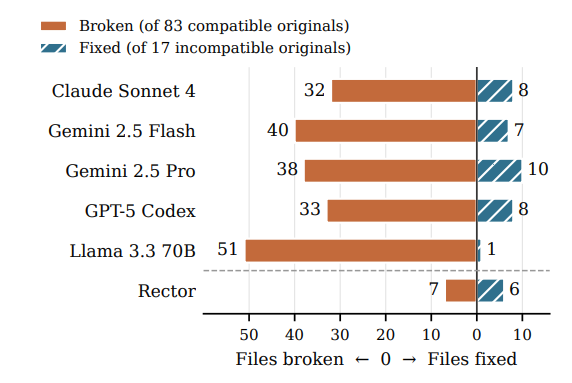
[…] Pasting a legacy file into an LLM and asking it to “modernize this” is an easy shortcut. But is the result better than leaving the code alone? In this paper, we study this single-file setting with five LLMs, each asked to modernize 100 WordPress 4.0 PHP files to PHP 8.3 while preserving behavior, with no project context or execution feedback. We evaluate every output with 630 hidden behavioral checks and 511 Rector-detected modernization findings. We compare against two baselines: the unchanged originals and the rule-based tool Rector. Often, the answer is no. Untouched, 83 files already pass every check; the best LLM leaves only 59. Each model breaks 32–51 working files while repairing at most 10, whereas Rector breaks 7 and repairs 6. Most of this damage is unnecessary. Only 37 findings (7%) require a change under PHP 8.3, yet in compatible files with no required change, the LLMs break 36–60% (Rector: 8%). The model with the highest modernization score is no more compatible than its closest competitors. Most regressed checks come from files that no longer load at all, often because of type declarations PHP itself rejects. These are errors that need no project context to avoid. Evaluations of LLM-based modernization should therefore measure against a no-change baseline and report modernization and behavioral preservation separately. […]
- Source: https://arxiv.org/pdf/2610.40269
This essentially means that if you use LLMs to migrate your codebase to a different framework or update it or ask it to find bugs in your code it will most likely spit out garbage or non issues and will break your code. This is a direct counterproof to people that say that LLMs “do not hallucinate anymore”.
LLMs take a lot more computing resources than a simple rule based tool and yet it did much worse, so why do you still blindly trust chatbot code because “models got better”?